

Retractable Awning Price in Malaysia: Manual vs Motorised Costs & Installation Factors
There is no single published RM price for a custom-installed retractable awning in Malaysia. The final cost depends on the awning’s dimensions, operating mechanism, fabric, frame, mounting conditions and installation scope. TK Kanvas does not publish a verified fixed-price list for its custom retractable awnings, so buyers should request a quotation based on their actual site rather than rely on a headline figure.
That distinction matters for anyone comparing manual and motorised options. A hand-operated awning over a small balcony and an electrically operated system outside a busy café may perform a similar shading function, but they involve different mechanisms, access arrangements and installation work. Even two awnings of identical width can require different structural solutions when their projections or mounting surfaces differ.
This guide explains the cost drivers that Malaysian homeowners, retail operators, property managers and project buyers should check before spending money. It also shows how to measure an awning, compare the actual scope of quotations and avoid mistaking an illustrative calculation for a selling price.
How Much Does a Retractable Awning Cost in Malaysia?
A custom retractable awning needs a site-specific price quotation; TK Kanvas has no verified standard RM selling price on its official product page. A responsible quotation should identify what will be manufactured, how it will be supported and which services are included, especially when an awning needs a bespoke width, projection or motorised drive.
In practical terms, “awning price” can describe several different purchases: the fabric and frame alone, a complete manually operated system, a motorised system, or a fully installed project with brackets, wiring and access equipment. Comparing these totals without matching the scope tells you very little about value. TK Kanvas offers both manual and motorised retractable awning solutions for residential and commercial spaces; the right question is what a specific installation must include.
For example, a café owner may need a six-metre frontage covered, but the price will also depend on projection, whether the wall can safely support the awning, and whether an electrical supply is available. A homeowner with a smaller balcony may have a simpler installation despite choosing a similar fabric. Neither example supports a reliable RM figure without a site assessment.
Which Factors Have the Greatest Effect on Retractable Awning Cost?
Width, projection and mounting requirements set the basic project scope; operation, materials and installation access then shape the final quotation. Manufacturers assess these factors together because changing one can affect the others. A longer projection, for instance, is not simply more fabric: it can change the arm arrangement and forces transferred into the building.
Start by defining the area that genuinely needs shade, then identify the operating conditions. A shopfront with customers passing beneath it needs a different access and installation plan from a private terrace. Likewise, a high-level façade with limited working space may require equipment or precautions that a ground-floor installation does not.
| Price driver | What changes the project scope | Practical point to confirm |
|---|---|---|
| Width and projection | Fabric area, arm configuration, structural loads and achievable coverage | Provide the required overall width and outward projection in millimetres. |
| Manual or motorised operation | Drive mechanism, controls, electrical work and commissioning | Specify hand-crank, switch or remote operation; ask what is actually supplied. |
| Frame and fabric specification | Finish, durability requirements, fabric performance and replacement options | Request the proposed material specifications rather than accepting a generic “premium fabric” description. |
| Fixing and supporting structure | Bracket positions, anchor design, substrate assessment and possible strengthening | Identify whether the fixing surface is reinforced concrete, masonry, steel or another material. |
| Site access and installation | Working height, access restrictions, installation equipment and disruption to operations | Share photographs showing access, nearby obstacles and operating hours. |
| Controls and accessories | Sensors, protective covers and other compatible optional components | Ask which accessories are included and which are priced separately. |
A useful quotation should show these decisions rather than hide them behind a single total. That makes it easier to understand why one custom design differs from another and, if necessary, adjust the specification without compromising essential safety requirements.
Is a Manual or Motorised Retractable Awning More Cost-Effective?
Manual operation generally involves fewer powered components, while a motorised system adds control convenience and electrical scope. Which is more cost-effective depends on how often the awning will be used, whether its position is easy to reach, and what maintenance or servicing the selected equipment requires. The cheaper purchase is not always the most suitable operating choice.
For a residential balcony used occasionally, a manual crank may be entirely practical. At a restaurant where staff need to extend or retract several units during daily operations, compatible motorised controls may reduce repetitive manual handling. However, buyers must still confirm motor specifications, access for servicing and what happens during a power interruption.
| Decision point | Manual retractable awning | Motorised retractable awning |
|---|---|---|
| Price components | Crank mechanism, arms, fabric, frame and installation | Motor, compatible controls, arms, fabric, frame, installation and any electrical works |
| Daily use | Best assessed against reach, size and frequency of operation | Useful where frequent adjustment or multiple users make manual operation less convenient |
| Installation checks | Wall support, clearance and safe access for cranking | Wall support plus power provision, wiring route, control placement and commissioning |
| After-sales considerations | Crank, arms, joints, fabric and replacement availability | Motor, controls, electrical components, arms, fabric and service access |
| Questions for TK Kanvas | Is this size suitable for manual operation? What parts are warranted? | What motor/control package is proposed, and who supplies and completes the electrical work? |
If a motorised installation needs new electrical wiring, the electrical portion must be planned and undertaken by appropriately registered personnel. Malaysia’s Energy Commission advises homeowners to appoint registered electrical contractors for residential wiring work. Ask the supplier to distinguish awning installation from any separately required electrical works in the quotation.
How Do Awning Width and Projection Affect the Price?
Width determines how far the awning spans along the wall; projection determines how far it extends outward. Together they influence shade coverage and the requirements for fabric, arms and mounting support. They are therefore more useful pricing inputs than the description “small” or “large”.
Consider a hypothetical 4.0 m-wide awning. With a 2.5 m projection, the simple plan area is 4.0 × 2.5 = 10.0 m². Increasing its projection to 3.0 m produces 4.0 × 3.0 = 12.0 m²—a 20% increase in plan area. That does not mean the quotation will increase by 20%. The longer extension may call for a different arm or mounting specification, and the usable shaded area also changes with sun angle. These figures illustrate dimensions, not an approved TK Kanvas model or price.
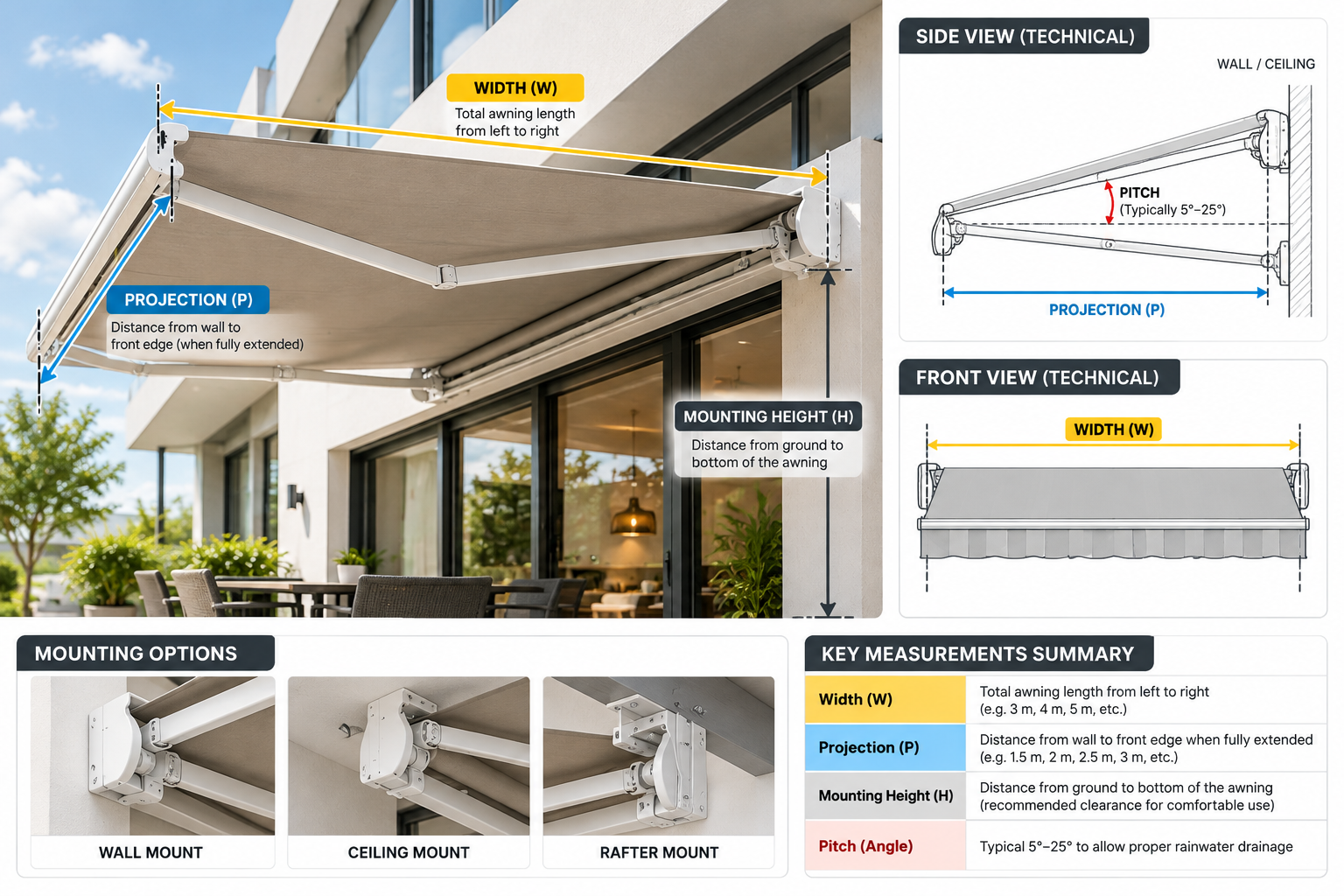
The required projection should follow the way people use the space. For example, a café might need coverage over tables and circulation space, not just the building’s doorway. At the same time, an excessively deep projection may create unnecessary cost or require a different shade arrangement. This is why a measurement sketch should show furniture, doors, signage and the intended operating area.
For guidance on the relationship between solar angle and external shading, the Australian Government’s YourHome shading guide explains why orientation and adjustable shading affect coverage. Its climate examples are Australian; they should not be treated as a fixed design rule for a Malaysian building.
Do Fabric and Frame Specifications Change the Cost?
Yes. Fabric performance, frame construction, coatings and component compatibility can change both the initial quotation and future maintenance requirements. Rather than choosing solely by colour or fabric weight, ask what the proposed material is designed to withstand and whether its documentation supports the intended use.
Depending on the product specification, awning fabrics may use different fibres and coatings with different colourfastness, cleanability, water resistance and appearance. These terms should not be used interchangeably: water-repellent fabric, for example, is not automatically suitable for prolonged pooling water. A restaurant may value stain resistance and cleaning access, while a residential patio may place greater emphasis on colour stability and visual appearance.
The frame deserves the same scrutiny. Buyers should confirm the actual material, finish, arm mechanism, fasteners and compatibility with the proposed projection and mounting structure. TK Kanvas describes a custom awning design, fabrication and installation service, but the fabric or frame selected for an individual quotation should still be identified in writing. Do not assume that materials cited for architectural tensile membrane structures are automatically the specification of a retractable awning.
Why Does Installation Scope Matter So Much to the Final Cost?
Installation cost depends on the condition of the building, the fixing arrangement, access and any additional work needed to make the system operable. Even a well-specified awning can be unsuitable if its mounting surface cannot accept the required loads. A quotation therefore needs more than the awning’s dimensions.
For example, fixing to an accessible reinforced-concrete frontage may involve a different process from fitting an awning to a lightweight façade, a location with concealed services or an upper-level balcony. The installer must establish an appropriate load path and anchorage arrangement for the particular building. A masonry finish alone does not prove that the underlying substrate can support the installation.
Ask whether the price includes the site survey, fixing design, brackets, access equipment, removal of an old awning, protection of surrounding finishes, commissioning and handover. For projects in managed buildings or rented shoplots, confirm any owner or management approvals before work starts. TK Kanvas lists in-house design, engineering, fabrication and installation capabilities, which makes it sensible to discuss these project interfaces early rather than after a quote has been accepted.
What Should You Check About Rain, Wind and Safe Operation?
Ask for the selected awning’s permitted operating conditions, rainwater management details and retraction instructions before choosing it. An awning that provides everyday shade must not automatically be treated as a storm-rated roof. Its performance depends on the specific product, fixing arrangement, pitch and exposure.
During Malaysian afternoon storms, the practical concern is not only whether the fabric resists water. Wind can load the extended awning, while an inadequate pitch or drainage route can allow water to collect. A motorised control or optional sensor may help users respond, but it does not eliminate the need to follow the manufacturer’s retraction instructions or manage an unexpected power failure.
As a technical reference, the published overview of EN 13561:2015 identifies performance and safety considerations for external blinds and awnings, including wind resistance. It is an international reference, not proof that a particular TK Kanvas model is certified or a universal Malaysian compliance requirement. Ask for the specific product’s documented rating and operating limits instead of applying one wind-speed figure to every installation.
What Should an Itemised Retractable Awning Quotation Include?
An accurate quotation should identify the awning system, its dimensions and materials, installation scope, exclusions and after-sales terms. A single lump-sum figure can be useful for budgeting, but only an itemised scope lets you check what will actually be delivered.
Suppose two quotations cover the same 4 m-wide shopfront. One includes a motor, controls, site access and commissioning; the other prices the awning assembly only. The totals are not directly comparable. Rather than choosing the lower number, align both specifications and identify every excluded item before evaluating value.
| Quotation item | What the written offer should specify | Why it matters |
|---|---|---|
| System configuration | Manual or motorised; proposed mechanism, frame and controls | Prevents ambiguity about which components are included |
| Dimensions and fabric | Overall width, projection, fabric specification, colour and finish | Confirms the coverage and material actually being priced |
| Mounting and structural scope | Proposed fixing locations, brackets, substrate assumptions and any engineering review | Identifies structural responsibilities and potential additional work |
| Installation and electrical work | Site survey, access equipment, labour, wiring, controls and commissioning as applicable | Separates the complete installed price from supply-only pricing |
| Delivery and programme | Delivery location, proposed installation schedule, access or operating-hour constraints | Clarifies logistical costs and scheduling assumptions |
| Warranty and service | Coverage for fabric, frame, mechanism and motor; inspection or maintenance provisions | Makes after-sales obligations and exclusions visible |
| Quotation conditions | Validity period, payment terms, exclusions and treatment of unforeseen work | Reduces disputes when site conditions or specifications change |
For a multi-unit commercial frontage, also ask whether controls, finishes and warranty terms are consistent across every awning. That prevents a project from being priced as though all units have identical access or wiring requirements when the site tells a different story.
What Information Should You Give TK Kanvas Before Requesting a Price?
Send a dimensioned photograph or sketch, describe the intended use and state whether you want manual or motorised operation. These details allow the TK Kanvas team to assess the correct type of system and identify where a site visit or additional structural information is needed.
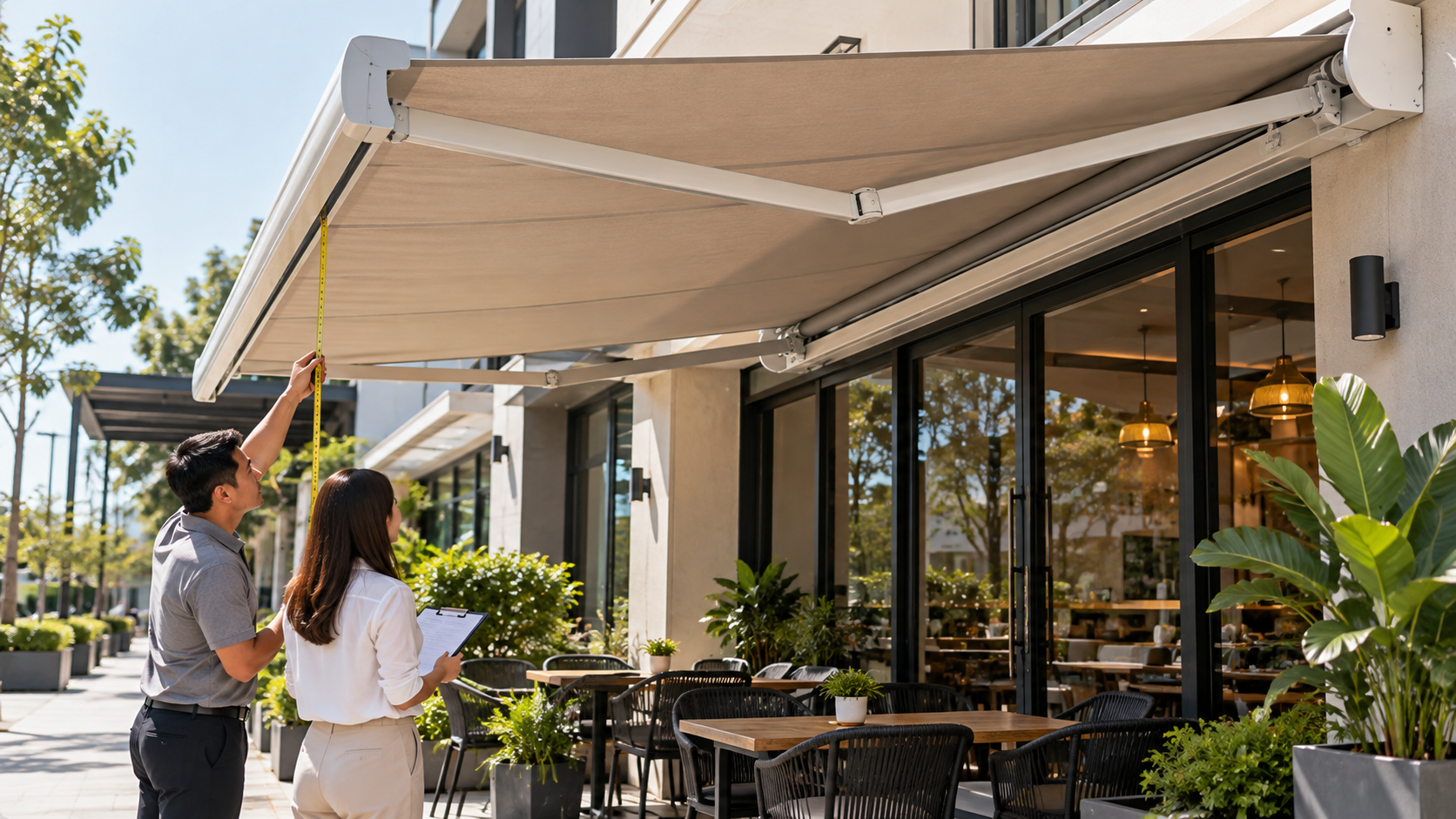
A buyer need not prepare professional drawings before making an enquiry. However, even approximate measurements become more useful when they distinguish the wall width from the desired outward projection and show the mounting height. Include obstacles such as drainage pipes, signage, shutters, balconies, lighting and air-conditioning equipment.
| Information to send | Example of a useful description | What TK Kanvas can clarify |
|---|---|---|
| Property and application | Residential balcony, shopfront or outdoor café seating in Penang | Suitable system type and site survey needs |
| Width, projection and height | Wall span about 4.0 m; desired projection about 2.5 m; mounting height to verify | Feasible dimensions and clearance |
| Mounting condition | Photographs of the wall and any known structural drawings | Fixing feasibility and need for additional assessment |
| Operation preference | Manual crank or motorised control; frequency of daily use | Mechanism and compatible control choices |
| Utilities and access | Existing electrical point, upper-floor access, surrounding footpath or vehicle movement | Electrical and installation scope |
| Performance priorities | Afternoon sun, occasional rain exposure, appearance and cleaning requirements | Fabric, pitch, operating-limit and maintenance questions |
For instance, a Butterworth shop owner could send frontage photographs and a rough width and projection, then explain that the awning must clear the roller shutter and shop signage. That is more actionable than asking for the price of a “standard shop awning”, because it reveals potential constraints before the quotation is prepared.
How Should You Decide Whether the Quoted Price Is Worthwhile?
Compare the price with the actual operating requirement, not simply with another number. A cost-effective awning provides the required shade and functionality with an appropriate fixing design, understandable operating limits and serviceable components. Removing essential installation or safety work to lower the quotation can make the comparison misleading.
If a homeowner rarely operates the awning and can reach a manual crank comfortably, motorisation may add little practical value. Conversely, a hospitality venue may place greater value on convenient operation across a busy frontage. In both cases, measure success by usable shade, operating convenience, maintenance expectations and the completeness of the proposed installation.
If you are evaluating the broader benefits of retractable shade rather than preparing a quotation, TK Kanvas also explains the use cases in its retractable awning investment guide. The purpose here is different: to help you specify the work and understand the cost.
Frequently Asked Questions
Can TK Kanvas replace the fabric without replacing the complete awning?
Fabric replacement may be possible when the existing frame and mechanism remain suitable and compatible with the replacement material. TK Kanvas describes workshop support and replacement-fabric capability, but a technician should first inspect the condition, dimensions and attachment method of the actual system.
Can several motorised awnings use one control?
Some motorised systems support grouped controls, but this depends on the selected motors, receivers, wiring and control architecture. Specify the required number of awnings and operating zones in the enquiry; do not assume that any remote will control every unit.
Can an existing manual retractable awning be converted to motorised operation later?
Sometimes, but only when its mechanism, shaft, frame and fixings are compatible with an approved motor conversion. Have the existing awning inspected before budgeting for a retrofit; the conversion may also require new electrical wiring.
Does a coastal property need different awning hardware or finishes?
Salt-laden air can increase corrosion exposure. Tell TK Kanvas if the building is close to the coast and ask which frame finish, fasteners, maintenance practices and warranty conditions suit that environment. Do not assume a standard finish is suitable for every coastal installation.
How long is a retractable awning quotation valid?
There is no universal validity period. Ask TK Kanvas to put the expiry date, included specifications and conditions for price changes in writing, particularly when fabrication or installation is scheduled well after the site survey.
Conclusion: Request the Right Specification, Not Just a Price
The most useful retractable awning price is one tied to a clearly defined installation. Check the required width and projection, choose manual or motorised operation based on actual use, verify the mounting conditions and ask the supplier to document the materials, weather limits and full scope of work. These steps make the final quotation more meaningful and reduce the risk of paying for a system that does not suit the site.
TK Kanvas designs, fabricates and installs custom awnings for residential and commercial applications in Malaysia. Sharing measurements, site photographs and operating requirements is the clearest starting point for discussing a suitable solution.
Need a Retractable Awning Quotation in Malaysia?
Tell TK Kanvas the installation location, approximate width and projection, preferred operation and any access constraints. The team can review your requirements and discuss a suitable custom retractable awning configuration.
